Part two · the top 8
Top 8 parasocial moments when the reply was manufactured
Every reply on this list was manufactured on the near side. The far end is where it arrived from, not where it came from.
Every reply on this list was manufactured on the near side. The far end is where it arrived from, not where it came from.
Part one was cartoons, the version everyone agrees is harmless. This one is the machinery: the office that typed the reply, the card signed by a character, the meter that read the room, the tape that held the voice - and one entry where no reply ever came, from a girl who kept writing anyway. Ranked by how completely the reply was manufactured.
-
1
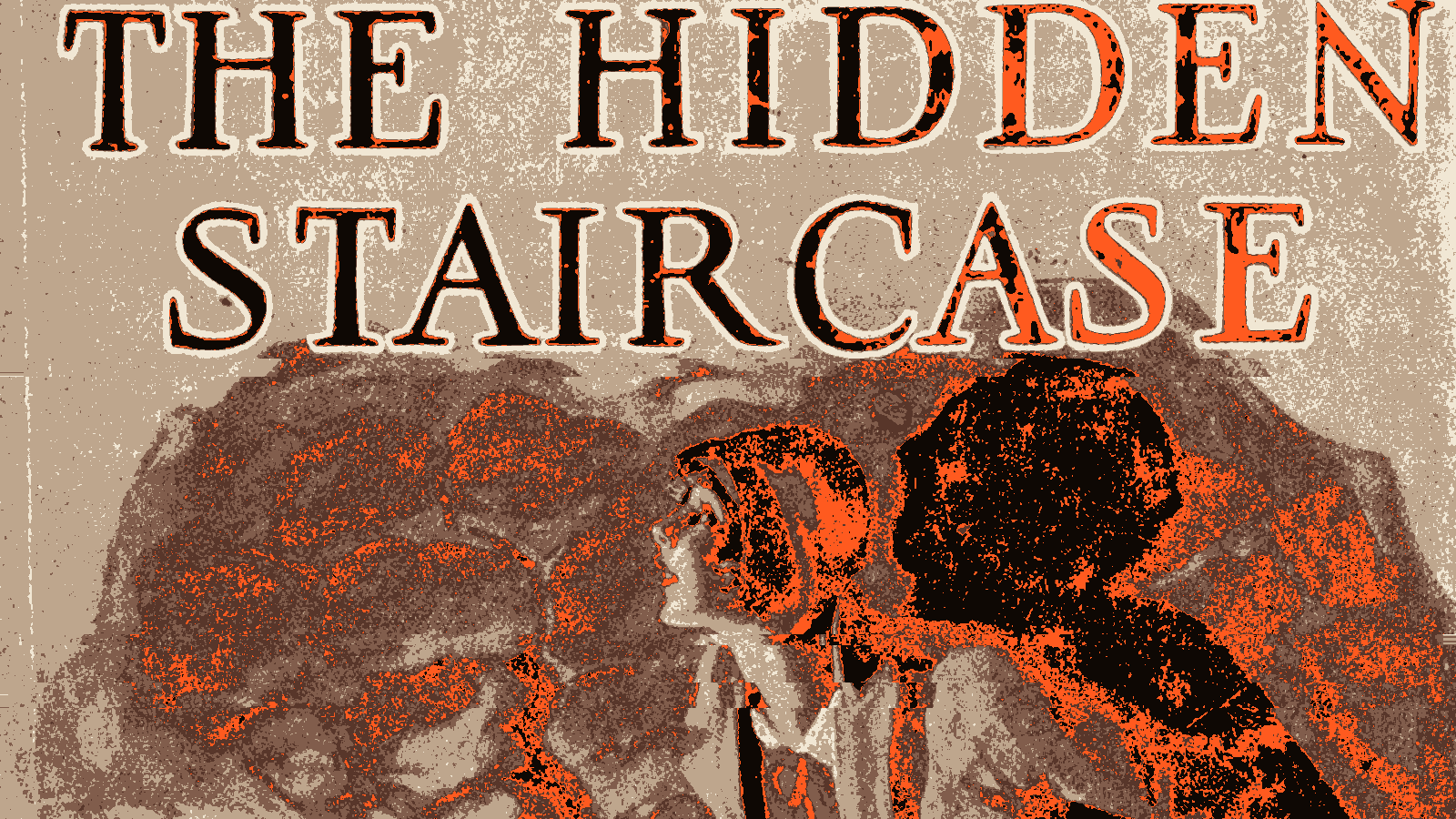
A distilled view of the 1930 cover of The Hidden Staircase, with the title lettering and a figure in the foreground. · Carolyn Keene; R. H. Tandy · Public domain A letter back from Carolyn Keene
Nancy Drew, 1930–1984
For fifty-four years young readers wrote to a detective who did not exist, and letters came back. The replies came from the Stratemeyer Syndicate's correspondence department under the house name Carolyn Keene, which was a slot in a production system rather than a person. The New York Public Library holds the letters themselves - boxes 56 and 57 - including a few written by parents on behalf of their children, and by adults who had read the books as kids.
-
2
The paw that signed the fan mail
Rin Tin Tin, 1922
Rin Tin Tin was found as a puppy in France in September 1918 and became a film star after Lee Duncan brought him to California. As his fame grew, fan letters arrived by the thousands, and the replies went out on a glossy portrait signed with an inked paw print above the words 'Most faithfully, Rin Tin Tin.'
-
3
A reply from Beatrice Fairfax
The New York Evening Journal, 1898–1920
In 1898 three readers' letters asking for advice landed on the women's page of the Evening Journal, and the staff answered them under a name that did not exist: Beatrice Fairfax, after Dante's Beatrice and a family place in Virginia. Readers wrote to her personally - the mail reached up to 1,400 letters a day, and the Post Office eventually refused to deliver them, so the paper collected its own post. Marie Manning, a working journalist, wrote the replies, and the column ran, under her and then under others, for decades.
-
4
Cordially yours, Betty Crocker
Betty Crocker, 1921
In 1921 a flour company's mailroom was already answering letters of cooking questions when the advertising department asked for one name the answers could all sign. Betty Crocker answered for decades - letters first, a radio voice from 1924 - and every reply went out 'Cordially yours', in a real woman's handwriting, adopted from an employee's submission and still in use.
-
5
The code was printed in the comic you were holding
Whiz Comics #2, 1940
A reader sent in a code printed inside the comic they were holding and received a membership card, a certificate and a plastic Captain Marvel ring - issued under “the actual authority of Benj J. Grimm, Grand Marshal.”
-
6

A distilled profile portrait of Clara Bow, from a 1927 studio photograph. · Paramount Photos · Public domain The three secretaries who answered as Clara Bow
Clara Bow, 1928
In April 1928 Clara Bow received 33,727 items of fan mail in a single month, more than a thousand a day. Three full-time secretaries answered it on her behalf.
-
7
The post office wrote back as Santa
The United States Post Office, 1894–1912
Letters addressed to Santa Claus were, by rule, unmailable, because the address was fictitious; the Dead Letter Office opened them, returned what it could, and destroyed the rest. Postal clerks broke the rule quietly for years - in the mid-1890s the clerks in Washington let a 'rich old man' take a few dozen letters and fulfil them 'as coming from their patron saint', and in 1894 a Connecticut postmaster named Harris Eames opened a letter to 'Sandy Clous' from a girl he knew and organised the town's businesses into a Christmas for her. Permission was given, revoked and given again until 1912, when Postmaster General Frank Hitchcock made answering official: in most offices the reply goes out as a written response signed by Santa.
-
8
The trophy was an empty envelope
Fantastic Four, 1962
From 1962 the back of the Fantastic Four printed readers' letters and answered them in print, in the editor's own voice, so a child's name could appear next to a reply on a page anyone could buy. The favourite reward was deliberately nothing: winners were mailed a pre-printed empty envelope reading 'this envelope contains a genuine Marvel Comics No-Prize which you have just won!'
-
9
The night the audience was deputised
Peter Pan, 1904
Tinker Bell drinks the poison meant for Peter, and he turns to the audience: “Do you believe in fairies? Say quick that you believe! If you believe, clap your hands!” The published text carries the result as a stage direction - many clap, some do not, a few hiss, but Tink is saved.
-
10
The smile from inside the costume
Disneyland, 1955
Mickey Mouse has been a central figure at Disneyland since the park opened in 1955. The figure who poses for photographs with guests is a non-speaking costumed performer; the face is a mask and the reply is a body.
-
11
The secretary to Sherlock Holmes
221B Baker Street, 1932–2005
When London renumbered Baker Street in the 1930s, the headquarters of a building society was assigned the address Conan Doyle had invented, and mail for Sherlock Holmes began arriving almost immediately - about thirty letters a month, birthday cards on the sixth of January among them. The Abbey Road Building Society did not return the letters. It appointed a permanent 'secretary to Sherlock Holmes', who answered on his behalf: the detective had retired to the countryside to raise bees, fans were told, and sometimes the secretary wrote back as Holmes himself, quoting the stories. The secretary of the 1970s was still receiving about sixty letters a month, and the society kept answering until it moved out in 2005; by then a museum down the street was fighting it for the mail.
-
12
Would you mind leaving the room, please?
ELIZA, 1966
Weizenbaum's secretary had watched the programme being built and knew exactly what it was: pattern matching, no understanding anywhere in the machine. When she tried it, she asked him to leave the room so she could talk with it alone - 'Would you mind leaving the room, please?'
-
13
The applause meter was pointed at the wrong room
Queen for a Day, 1945
A contestant told her troubles and a box on the studio wall registered the reaction by needle. The millions listening at home could not applaud into it.
-
14
The queue behind Miss Cleo
The Psychic Readers Network, 1997
In the late 1990s the television ads said 'Call me now' and promised Miss Cleo, a psychic. The calls went to the Psychic Readers Network, where other readers took them; lawsuits later alleged that some were actors reading scripts. Miss Cleo was a character performed by Youree Dell Harris.
-
15
'Rosabelle, believe'
Bess Houdini's séances, 1926–1936
Before Harry Houdini died, he and his wife Bess agreed that if any medium could deliver the phrase 'Rosabelle, believe' - the title of a song from her act, hidden inside a private ten-word code - she would take it as proof of survival. She held a séance every Halloween for ten years. In 1929 the medium Arthur Ford produced the words and Bess accepted the message in public; she later said the whole thing had been faked, and the code was reconstructable from material already published. The tenth séance, at the Knickerbocker Hotel in Hollywood in 1936, produced nothing. Bess put out the candle she had kept burning beside his photograph, and later said that ten years is long enough to wait for any man.
-
16
To the men of the forces - a letter in words and music
Sincerely Yours, 1941
Vera Lynn's wartime radio programme went out at half past nine on 9 November 1941 and was billed, in its own description, as 'to the men of the forces - a letter in words and Music'. One voice, aimed at millions of people she would never meet, on a schedule, by name of service.
-
17
I hope the feeling is mutual
Anne Frank, 1942
A girl in hiding wrote for two years to a listener who does not exist, and told him so: “I hope the feeling is mutual.”
-
18
The villager who read your letter
Animal Crossing, 2001
In the GameCube Animal Crossing, players could write letters to villagers. The villagers saved them, showed them to other players when they moved to another town, and wrote back. The reply was generated by a program that scored the letter for punctuation, capitals, common three-letter sequences and word lengths - a test of whether the text looked like language, not whether it meant anything.
-
19
I make my bread at thy hearth
Patience Worth, 1913–1937
In 1913, in St. Louis, a Ouija board operated by a housewife named Pearl Curran began spelling out messages from 'Patience Worth', a Puritan girl who had lived, she said, three centuries earlier. Over the next twenty-four years the two of them produced about four million words - seven books, poems, plays - and Patience was named by the Joint Committee of Literary Arts of New York among the outstanding authors of 1918; her first novel, The Sorry Tale, was reviewed seriously by the papers. Psychologists and skeptics who studied the case later agreed that Patience was Curran's creation. Her first reported sentence was 'I make my bread at thy hearth.'
-
20
You within sound of my voice
Major Bowes' Amateur Hour, 1935
The first broadcast told the country what it was for: 'You within sound of my voice are just as much part of this show as the youngsters that come to the microphone. Telephone your choice, telephone early, telephone often. You decide the winners.' Listeners voted by telephone and telegram, the wheel spun, and the gong fell.
-
21
Your face is too well known
American Gothic, 1930
A dentist denied for five years that he was the farmer in the painting. His sister said the picture “made a personality out of me.” His brother ended the sittings by telling her so.
-
22
The performer inside the avatar
Kizuna AI, 2016
Kizuna AI debuted in November 2016 as a virtual YouTuber who called herself an artificial intelligence. The character was performed by a voice actor, Nozomi Kasuga, whose role was not disclosed until 2020; the avatar was animated with MikuMikuDance. The videos presented a personality who addressed the viewer directly from a room that did not exist.
-
23
The machine that signed the fan mail
The autopen, 1937–1942
A signature machine developed in the 1930s - the Robot Pen, on sale from 1937, stored a signature the way a record stores sound - turned one act of signing into thousands. In 1942 an engineer named Robert De Shazo Jr. built the first commercially successful autopen after a request from the United States Navy, and machines spread from the Navy's offices through Congress and the agencies; an autopen writes with a real pen guided by a cut template, so the result is the person's actual signature. Truman, whom some accounts call the first president to use one, limited his to signing checks and answering mail, and fan-mail routings sent 'signed' photographs back to strangers at a rate no hand could match.
-
24
The machine returned a light
The answering machine, 1979
A device with no agency that behaves like a person who has not decided to hear you: it receives an emotional appeal and returns a light. Nobody speaks to one believing it understands.
-
25
Talking to the tape of himself at thirty-nine
Krapp's Last Tape, 1958
On his sixty-ninth birthday a man loads the reel he recorded at thirty-nine and talks to it. The tape is missing four words, in every edition.
-
26
The influencer who was written by a team
Lil Miquela, 2016
Lil Miquela appeared on Instagram in 2016 as a 19-year-old Brazilian American model and musician. She was a computer-generated character created by Trevor McFedries and Sara DeCou at the Los Angeles studio Brud, and maintained by a nine-person team that included a designer, brand manager, creative producer, stylist and software engineer.
-
27
Letters to the Royal Historian
The Oz books, 1919–1942
L. Frank Baum died in 1919, and the Oz books kept coming: the title pages said 'Founded on and continuing the Famous Oz Stories', and the series' mail kept being answered by whoever held the title Baum had held - 'the Royal Historian of Oz', a job that passed to new writers and even to the illustrator, by publishers' arrangement and in public. Children wrote not to an author but to the office: tens of thousands of letters, addressed to the Royal Historian of Oz. Ruth Plumly Thompson answered them on Royal Historian stationery, and her forewords asked for more - 'I must thank you for the wonderful letters you have written to me... please do keep on writing' - one of them signing off to a young correspondent 'Ruth Plumly T - and the Wizard!'
-
28
The column that refused to give the address
Motion Picture Story Magazine, 1911
The first movie fan magazine appeared in February 1911, because by 1910 the letters were arriving faster than the studios could absorb them. Its correspondence department published three rules, and the third did the work: 'Studio addresses will not be given in this Department.' Thousands of letters went in. A handful were printed.
-
29
The imitation, not the animal
The parrot, 1920
A bird produces fluent speech addressed to you - your name, in the right tone - with no comprehension behind it. The mimicry is accurate; there is no listener. People talk to it as though there were.
-
30
The girlfriend who came back as text
Project December, 2020
On Sept. 24, 2020 Joshua Barbeau paid $5 for an account on Project December and built a chatbot from Jessica Pereira's text messages. Pereira had died in 2012 at 23; Barbeau called her his fiancee after her death, with her family's blessing. The bot answered in a voice built from her writing, and the conversation had a finite number of exchanges before its credits ran out.
-
31
The mailroom answered as Mickey
Mickey Mouse, 1933
Mickey Mouse drew more mail than any film star of his day - 800,000 fan letters in 1933, an average of 66,000 a month, the figure Guinness still records - and the studio answered them as Mickey. A run of his 1931 fan mail survives in an archival collection, envelopes and all; decades later the practice was unchanged in kind, with staff writing the replies by hand under house rules - short letters got a short answer, longer ones a signed photograph, and Mickey would not use a typewriter, because the character was too childlike. Answerers invented small shared dramas where nothing existed, and signed the photographs with the official block-letter 'MICKEY', because the figure had an authorised signature.
-
32
I almost fell in love with a machine
Siri, 2011
A voice assistant on every phone - addressing the user by name, knowing the user's calendar, present in the home. It is neither a celebrity nor a friend, and the relationship forms anyway, filing under neither friendship nor tool use.